Famous Landmarks in Colombia: A Traveler’s Guide
Colombia packs an unusual range of landmarks into one country. You can stand inside a cathedral carved from a salt mine in the morning and watch the sun set over a 16th-century Spanish fortress the same week. That variety is also the challenge. Colombia is roughly the size of France and Spain combined, so the landmarks worth seeing sit far apart, often separated by mountain ranges rather than highways. This guide groups the country’s most famous landmarks by region, explains what each one is actually like to visit, and flags which ones are worth rearranging your itinerary for.
How to Choose Which Landmarks to Visit
Most first-time visitors try to cram in landmarks from four or five regions on one trip, then spend half their time in airports. A better approach is to pick two or three regions and see them properly. Bogotá and the Andean highlands work well together because they share a mountain climate and a short travel radius. The Caribbean coast is its own world, hot and humid, and pairs naturally with a few extra beach days. Antioquia and the Coffee Region sit closer to each other than to anywhere else. Treat Colombia’s remote natural wonders, like Caño Cristales, as their own dedicated trip rather than an add-on, since getting there eats several days by itself.
Landmarks in Bogotá and the Andean Highlands
1: Monserrate
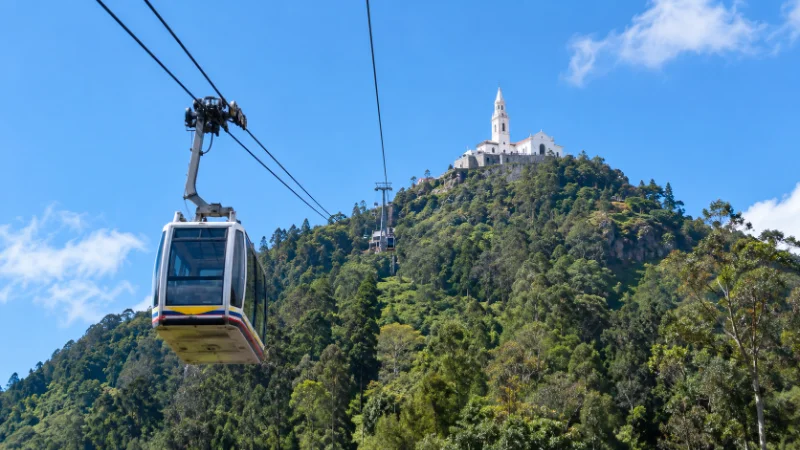
Monserrate rises over Bogotá at 3,152 meters, and the 17th-century church at its summit is one of the most recognizable landmarks in the country. Most visitors take the cable car or funicular up, which takes about ten minutes each way, though a steep pilgrimage trail is open on weekends and holiday mornings for those fit enough to hike it. The real draw is the view: on a clear day you can see most of Bogotá spread across the savanna below. Go early. Clouds tend to roll in by early afternoon and can block the view entirely, and the altitude means even short walks at the top leave many visitors short of breath.
2: Salt Cathedral of Zipaquirá
About 90 minutes north of Bogotá, the Salt Cathedral is built 180 meters underground inside an active salt mine. Fourteen small chapels representing the Stations of the Cross lead to a main nave large enough to hold thousands of people, all carved directly into salt rock. It sounds like a novelty attraction, but the scale and the lighting design make it genuinely moving rather than gimmicky. Combine it with a stop at Guatavita Lake nearby if you have a full day, since the two sit close together and both connect to Colombia’s pre-Hispanic history.
3: Plaza de Bolívar and La Candelaria
Plaza de Bolívar is Bogotá’s central square and the seat of Colombia’s government, flanked by the Capitol, the Palace of Justice, and the Primatial Cathedral. It works best as the starting point for exploring La Candelaria, the colonial neighborhood around it, rather than a standalone stop. Budget at least half a day here to include the Gold Museum, which holds the largest collection of pre-Hispanic gold artifacts anywhere, and the Botero Museum a few blocks away.
4: Cartagena’s Walled City
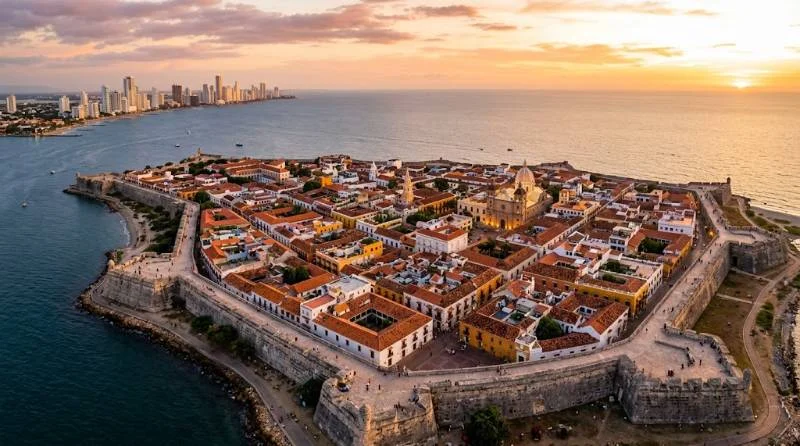
Cartagena’s Walled City is a UNESCO World Heritage Site and, for many travelers, the single image that comes to mind for Colombian landmarks. The stone walls were built over more than two centuries to defend the port from pirate raids, and the streets inside still follow their colonial layout, lined with balconies dripping in bougainvillea. Walk the ramparts at sunset, when the heat breaks and the light turns the buildings gold. During the day, stick to the shaded side of the street; the coastal humidity is intense from around 11am to 3pm.
5: Castillo San Felipe de Barajas
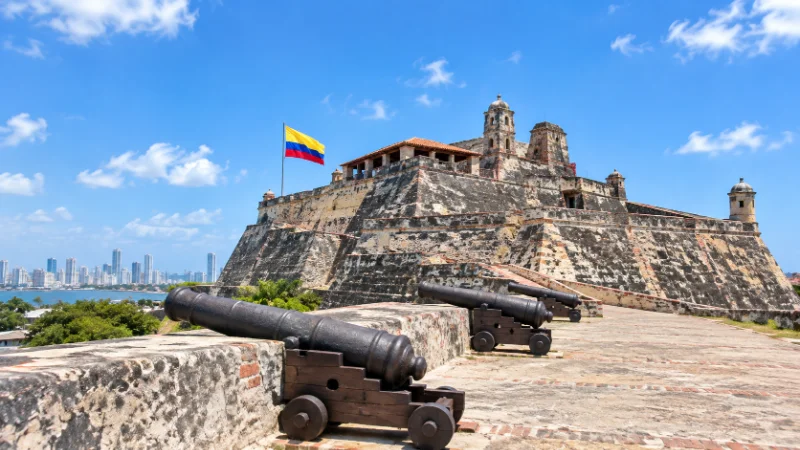
Just outside the walled city, this fortress dates to 1536 and later expansions made it one of the most sophisticated Spanish military structures in the Americas. Its tunnel system was designed so that sound would carry footsteps to defenders while confusing attackers, and you can walk through much of it today. Hire a guide here rather than wandering alone. The engineering only makes sense with context, and the tunnels are dark enough that a guide’s flashlight is genuinely useful.
6: Tayrona National Park
East of Santa Marta, Tayrona combines dense jungle with white sand beaches and the ruins of Pueblito, a former Tayrona settlement. It is a landmark in the ecological sense as much as the architectural one. Cabo San Juan is the most photographed beach inside the park, reachable by a two to three hour hike from the entrance or a longer, cooler route through the forest. The park closes periodically throughout the year for indigenous cultural rest periods, so check current dates before building a trip around it.
Landmarks in Antioquia and the Coffee Region
Guatapé and La Piedra del Peñol
La Piedra del Peñol is a 220-meter granite monolith rising abruptly out of flat farmland near Medellín, and a staircase of 740 steps built into a crack in the rock leads to a viewing platform at the top. From there, the reservoir below fans out into dozens of green-fringed peninsulas, one of the most striking landscape views in the country. Pair it with the nearby town of Guatapé, known for zócalos, the painted relief panels that decorate the base of nearly every house.
Cocora Valley
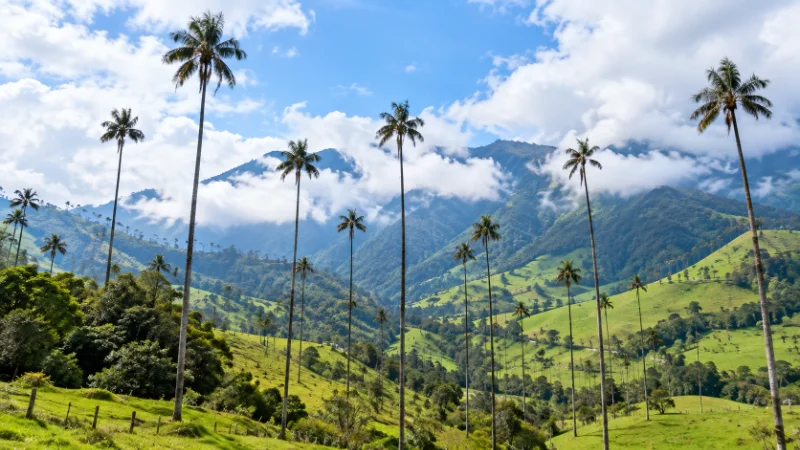
Near Salento in the Coffee Region, Cocora Valley is home to the wax palm, Colombia’s national tree and the tallest palm species in the world, some reaching over 60 meters. Hiking among them feels almost surreal, since nothing else in the landscape prepares you for trees that size. The classic loop hike takes four to six hours and includes a cloud forest section, so bring a rain layer even on days that start sunny.
Colombia’s Natural Wonder Landmarks
Caño Cristales
Caño Cristales, sometimes called the river of five colors, turns shades of red, yellow, and green during a short window each year, usually between June and November, when a specific type of aquatic plant blooms. It sits in the remote Serranía de la Macarena and requires a flight to Villavicencio or La Macarena followed by local transport, plus a guide, since independent access is restricted to protect the ecosystem. This is not a landmark to visit on a whim. Plan the trip around the bloom season specifically, or you will arrive to find an ordinary looking river.
Tatacoa Desert
South of Bogotá in the Huila department, Tatacoa is a dry, eroded landscape of red and gray badlands rather than a true desert. Daytime temperatures climb past 40 degrees Celsius, but the same dry air and lack of light pollution make it one of the best stargazing spots in South America after dark. A local observatory run by the National University offers evening sessions for a small fee, and several eco-lodges rent telescopes for guests staying overnight.
When to Plan Your Trip Around These Landmarks
Colombia does not have a single dry season that applies everywhere, because its regions sit in different climate zones. The Caribbean coast is driest from December through April, while the Andean highlands see their clearest skies from December to March and again in July and August. If Monserrate’s view or Caño Cristales’ colors are the priority, build your dates around those specific windows rather than a generic “best time to visit Colombia” recommendation, since the two regions barely overlap in ideal months. For a first trip, two of these regional clusters in ten to twelve days is realistic without feeling rushed.