Things to Do in Bhutan on Your First Trip
If you’re planning things to do in Bhutan, the short answer is this: hike to Tiger’s Nest Monastery, walk through Punakha Dzong, wander Thimphu’s markets, and build in at least one full day with no fixed plan. Bhutan is a small country, and most first trips move through Paro, Thimphu, and Punakha in a loop that takes five to seven days. Everything below is arranged in the order most visitors actually travel it.
When to Visit Bhutan for the Best Experience
Bhutan is a year-round destination, but two windows stand out. Spring, from March to May, brings blooming rhododendrons and clear mountain views. Autumn, from September to November, has the driest air and the sharpest visibility for photos of the Himalayas.
Winter is quieter and colder, especially in Bumthang and higher valleys, but Thimphu stays mild enough for sightseeing. Summer brings the monsoon, which can wash out mountain roads and cloud over the peaks, so most travelers avoid June through August unless they’re chasing a specific festival date.
Paro: Where Most Trips Begin
Paro is Bhutan’s only international airport town, and it holds two of the country’s most photographed sites.
Hike to Tiger’s Nest Monastery
Paro Taktsang, known as Tiger’s Nest, clings to a cliff about 900 meters above the valley floor. The round-trip hike takes most people four to six hours, and a cafeteria roughly halfway up gives you a place to rest and eat before the steeper final stretch.
Ponies can carry you partway up, but the last section to the monastery is on foot only, including a set of stone steps down into a gorge and back up to the entrance. Go early. The trail gets crowded by mid-morning, and the light is better for photos before 9 a.m.
Wander Paro’s Old Town and National Museum
Paro’s main street is lined with traditional timber-frame buildings, small weaving shops, and family-run restaurants. The National Museum, housed in a former watchtower called Ta Dzong, holds thangka paintings, ancient weapons, and a stamp collection that includes some of the world’s first 3D postage stamps.
Rinpung Dzong sits just below the museum and is still an active government and monastic building, so visiting hours are limited to the afternoon on weekdays.
Thimphu: Bhutan’s Capital and Cultural Hub
Thimphu is about an hour’s drive from Paro and remains one of the few capital cities in the world without a single traffic light. Traffic is directed by hand at the main intersection instead.
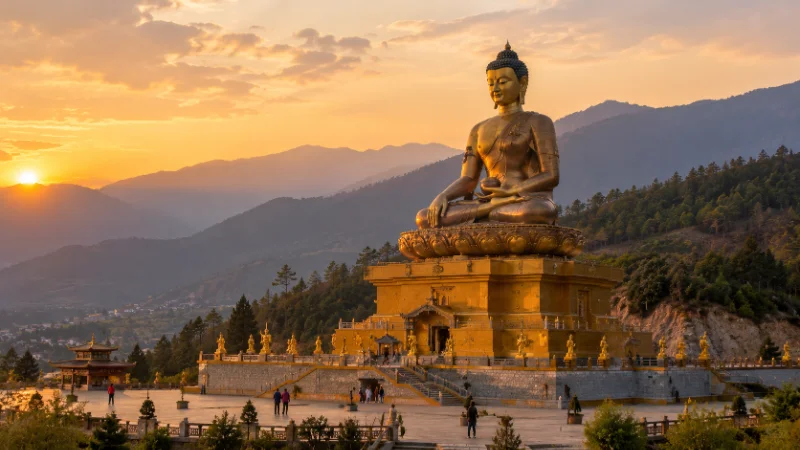
1. See the Buddha Dordenma Statue
The Buddha Dordenma sits on a hillside above the city and stands roughly 51.5 meters tall, making it one of the largest Buddha statues in the region. Inside the base is a hall containing over 100,000 smaller Buddha statues, and the viewpoint outside gives one of the best skyline shots of Thimphu.
2. Visit the Centenary Farmers Market
On weekends, farmers from across the region set up stalls along the Wang Chhu river selling chilies, cheese, yak butter, and dried fish. It’s one of the few places in Bhutan where you can talk directly with growers and see how central chilies are to the local diet, not as a garnish but as the main vegetable in dishes like ema datshi.
3. Tour Tashichho Dzong
Tashichho Dzong houses the throne room of the King of Bhutan and the offices of several government ministries, alongside monastic quarters. It’s open to visitors in the late afternoon on weekdays, once official business winds down, and the whitewashed courtyards are especially striking in the evening light.
Punakha: Dzongs, Rivers, and Suspension Bridges
Punakha sits a three-hour drive from Thimphu over the Dochula Pass, which on a clear day offers a wide view of the eastern Himalayan range and a hillside of 108 memorial chortens.
Explore Punakha Dzong
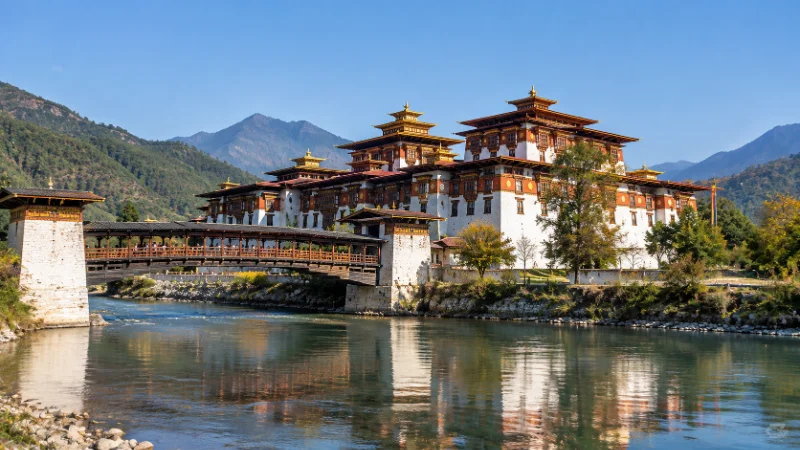
Punakha Dzong, set at the junction of the Pho Chhu and Mo Chhu rivers, is widely considered Bhutan’s most beautiful fortress. It served as the seat of government until the 1950s and is still where the King of Bhutan’s coronation and royal wedding ceremonies have taken place in recent years.
Jacaranda trees bloom purple around the dzong in late March and early April, which is one reason spring travel dates fill up early.
Cross Punakha Suspension Bridge
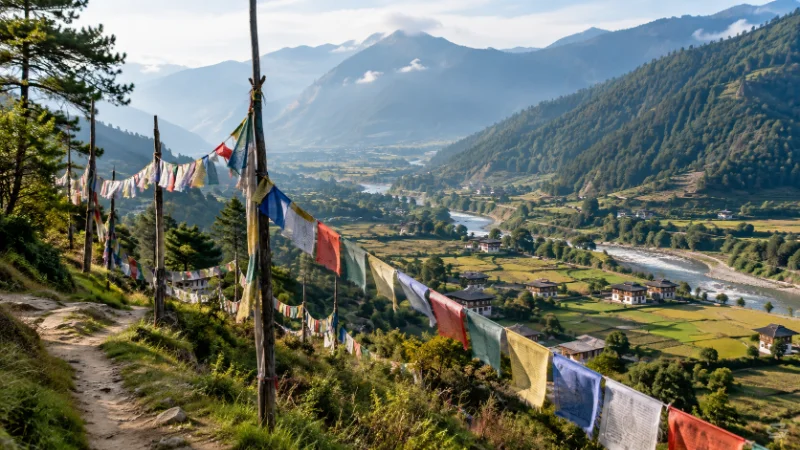
At around 160 meters, this is one of the longest suspension bridges in Bhutan, strung with prayer flags and crossing the Mo Chhu river to a small village on the other side. It takes about ten minutes to walk and offers a different, ground-level view of the valley than the dzong itself.
Try White Water Rafting on the Mo Chhu
Local operators run short rafting trips on the Mo Chhu, usually a gentle Class II to III stretch that ends near the dzong. It’s a good option for travelers who want an active break between temple visits, and most trips run under two hours.
Trek Through the Bumthang Valley
Bumthang, in central Bhutan, is considered the spiritual heartland of the country and holds some of its oldest temples, including Jambay Lhakhang and Kurjey Lhakhang. The valley is also known for buckwheat farming, apple orchards, and small-batch cheese and honey production, a legacy of Swiss agricultural aid projects from the 1960s.
Multi-day treks in the region range from the short Bumthang Cultural Trek to longer routes through Phobjikha Valley, home to black-necked cranes that migrate there from the Tibetan Plateau each winter. Phobjikha has no electricity poles or overhead wires by local regulation, kept underground specifically to protect the cranes’ flight paths.
Getting to Bumthang from Punakha means crossing two more passes, Pele La and Yotong La, both above 3,300 meters, so pack a warm layer even if the valleys below feel mild. Most itineraries budget two full days here, one for the temple circuit around Jakar and one for a farmhouse visit or a short hike into the surrounding hills.
Visit a Local Farmhouse
Several families in Bumthang and the Phobjikha Valley open their homes to visitors for lunch or an overnight stay, giving you a closer look at how rural Bhutanese households actually live. Expect a wood stove in the kitchen, a shared low table, and a demonstration of how buckwheat pancakes or noodles are made from scratch.
Some farmhouses also offer a traditional hot stone bath, where river stones are heated in a fire and dropped into a wooden tub filled with water and local herbs. It’s a slow, low-tech way to end a day of driving or trekking, and it’s become one of the more requested add-ons for travelers who want something beyond temple visits.
Experience Local Life and Traditions
Attend a Tshechu Festival
Tshechus are religious festivals held at dzongs and monasteries throughout the year, featuring masked cham dances performed by monks and laypeople in elaborate costumes. The Paro Tshechu and Thimphu Tshechu are the two largest and draw visitors from across the country, so book accommodation well ahead if your trip lines up with festival dates.
Dates shift each year based on the lunar calendar, so check the Tourism Council of Bhutan’s calendar before locking in travel plans.
Eat Ema Datshi and Other Bhutanese Dishes
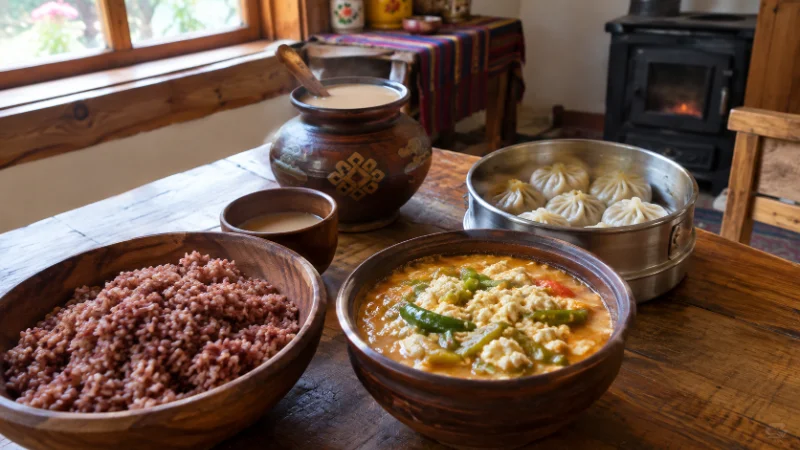
Ema datshi, a stew of green or red chilies in melted cheese, is the closest thing Bhutan has to a national dish. Other staples worth trying include red rice, a short-grain variety grown at high altitude, momos filled with meat or cheese, and suja, a salted butter tea served at most guesthouses.
Most tour packages include meals at hotel restaurants, but asking a guide to stop at a local farmhouse for lunch usually gets you a more home-style version of the same dishes.
Getting to and Around Bhutan
Flying Into Paro
Paro International Airport sits in a narrow valley surrounded by peaks, and only a small number of pilots are certified to land there because of the terrain. Flights run mainly from Delhi, Kolkata, Bangkok, Kathmandu, Singapore, and Dhaka, operated by Drukair or Bhutan Airlines, and a window seat on a clear day gives you a view of the Himalayas that includes Everest on some routes.
There’s no rail network in Bhutan, so every domestic leg of your trip happens by road. Distances look short on a map but take longer than expected because the roads wind through mountain passes rather than running straight.
Hiring a Guide and Driver
Most nationalities are required to book their trip through a licensed Bhutanese tour operator, who arranges a guide and driver for the length of your stay. This isn’t just a formality. Guides carry real local knowledge about which dzongs are open that day, when festivals fall, and which trails are muddy after rain, and a good one shapes the trip as much as the itinerary does.
Drives between Paro, Thimphu, and Punakha run two to three hours each, so building in a rest stop or a short roadside walk keeps the days from feeling rushed.
Plan Around the Sustainable Development Fee
Bhutan charges most international tourists a Sustainable Development Fee (SDF) of 100 US dollars per person, per night, a rate the government has held since 2023 and confirmed through 31 August 2027. Children aged six to twelve pay half that rate, and children under six travel free. Travelers from India pay a separate, lower rate of around 1,200 ngultrum per night.
The SDF is billed separately from your hotel, meals, transport, and guide, and it’s paid in advance through a licensed Bhutanese tour operator as part of your visa application, since independent travel without a registered operator isn’t permitted for most nationalities. Budgeting for the SDF alongside the standalone 40 US dollar visa fee before you build out a daily itinerary will save you surprises later.
Bhutan’s tourism model is built around fewer visitors staying longer and spending more locally, rather than high volume. That’s part of why so many of these sites, from Tiger’s Nest at dawn to Punakha Dzong without a crowd, still feel uncrowded even in peak season.